Bathroom Fan CFM Calculator
Find the minimum exhaust fan airflow (CFM) needed for your bathroom by entering your room details below.
List of the Best Bathroom Exhaust Fan:


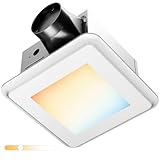
Understanding Bathroom Exhaust Fan Sizing
A properly sized bathroom exhaust fan is essential for removing moisture, odors, and airborne pollutants from your bathroom. Without adequate ventilation, excess humidity can lead to mold growth, peeling paint, warped cabinetry, and respiratory irritation. The key measurement for sizing a bathroom fan is CFM—cubic feet per minute—which indicates how much air the fan can move. Choosing the right CFM is a balance: too little airflow leaves moisture behind, while too much can waste energy, create excessive noise, and pull conditioned air out of your home unnecessarily.
This guide explains the factors that determine the correct CFM for your bathroom, how to account for ductwork and installation conditions, and how to choose a fan that will keep your space dry, comfortable, and healthy for years to come.
Why Bathroom Fan CFM Matters
Bathrooms are the most moisture-prone rooms in a typical home. A single shower can release several pints of water vapor into the air. If that moisture is not exhausted promptly, it condenses on mirrors, walls, ceilings, and grout lines. Over time, this leads to mold, mildew, and structural damage. A fan with insufficient CFM may run for 30 minutes and still leave the room feeling damp. A fan with excessive CFM, on the other hand, can depressurize the home, pulling in unconditioned air from attics or crawl spaces and increasing heating and cooling costs.
The industry standard for bathroom ventilation is based on air changes per hour (ACH)—the number of times the entire volume of air in the room is replaced each hour. For bathrooms, most building codes and ventilation experts recommend 8 to 12 air changes per hour, with higher rates for larger bathrooms, heavy moisture use, or humid climates. The CFM calculation is straightforward: multiply the room's volume (cubic feet) by the desired ACH, then divide by 60 to convert from hours to minutes. For example, a 10 ft × 8 ft bathroom with an 8 ft ceiling has a volume of 640 cubic feet. At 10 ACH, the required CFM is 640 × 10 ÷ 60 ≈ 107 CFM.
Key Sizing Factors
Room Volume
- Length × width × ceiling height = cubic feet
- Volume is the base for all CFM calculations
- Higher ceilings increase required airflow
- Open or connected spaces require more capacity
Air Changes Per Hour
- 8 ACH: minimum for small, low-use bathrooms
- 10 ACH: recommended for most full bathrooms
- 12 ACH: heavy moisture or frequent shower use
- 15 ACH: humid climates or very large bathrooms
Fixture Load
- Showers and tubs release the most moisture
- Jacuzzi tubs and steam showers need more CFM
- Multiple showerheads increase humidity output
- Toilets and sinks add odors but little moisture
Ductwork & Resistance
- Long duct runs reduce effective airflow
- Elbows and bends add static pressure
- Smaller duct diameter restricts airflow
- Roof or wall vent termination affects performance
Bathroom Fan CFM Sizing Guidelines
| Room Size (sq ft) | Ceiling Height | Recommended CFM (10 ACH) | High-Moisture CFM (12 ACH) |
|---|---|---|---|
| Up to 40 | 8 ft | 50 – 60 | 60 – 75 |
| 40 – 60 | 8 ft | 60 – 80 | 75 – 100 |
| 60 – 80 | 8 ft | 80 – 110 | 100 – 130 |
| 80 – 100 | 8 ft | 110 – 135 | 130 – 160 |
| 100 – 120 | 8 ft | 135 – 160 | 160 – 190 |
| 120 – 150 | 8 ft | 160 – 200 | 190 – 240 |
| 150+ | 8 ft | 200+ | 240+ |
Adjustment Factors
Ceiling Height
- 8 ft: baseline calculation
- 9 ft: add 12% to CFM
- 10 ft: add 25% to CFM
- 12 ft: add 50% to CFM
Duct Run & Bends
- Under 10 ft, no bends: no adjustment
- 10–20 ft or 1–2 bends: add 10%
- 20–30 ft or 3–4 bends: add 20%
- Over 30 ft or 5+ bends: add 30%+
Duct Diameter
- 6": best airflow, minimal resistance
- 5": good for most residential fans
- 4": common but restrictive on long runs
- 3": avoid unless absolutely necessary
Bathroom Type
- Half bath / powder room: 50 CFM minimum
- Full bath: size by volume and ACH
- Master bath: consider 12–15 ACH
- Utility / laundry: 10–12 ACH for moisture
Noise Ratings: Sones Explained
CFM tells you how much air a fan moves, but sones tell you how loud it will be. A sone is a unit of perceived loudness. A quiet library is about 1 sone, a refrigerator hum is around 2 sones, and normal conversation is roughly 4 sones. For bathrooms, most people prefer a fan rated at 2 sones or lower. Fans rated below 1.0 sone are exceptionally quiet and are ideal for master bathrooms or bathrooms adjacent to bedrooms. High-CFM fans (150 CFM and above) tend to be louder, but modern DC-motor models can move large volumes of air at surprisingly low noise levels. When comparing fans, always check both the CFM and the sone rating—a fan that meets your CFM requirement but runs at 4 or 5 sones may be annoying enough that you avoid using it.
It is also important to understand that CFM and sones are measured under standardized conditions (usually 0.1 inch of static pressure for HVI-certified fans). In real installations with long ducts or small duct diameters, actual airflow may be lower and noise may be higher. This is why it is wise to choose a fan with a slightly higher CFM rating than the minimum calculated, especially if your duct run is long or complex.
Continuous vs. Intermittent Ventilation
There are two main approaches to bathroom ventilation: intermittent and continuous. Intermittent fans run only when the bathroom is in use, typically controlled by a wall switch, timer, or humidity sensor. They are the most common choice in residential bathrooms. Continuous fans run all the time at low speed, providing constant air exchange. Continuous ventilation is often used in tightly built homes where overall indoor air quality needs to be managed. For intermittent fans, ASHRAE 62.2 recommends a minimum of 50 CFM. For continuous fans, the minimum is 20 CFM. If you are sizing an intermittent fan for a large or heavily used bathroom, you will likely need well over 100 CFM.
Some fans offer dual-speed operation: high speed for showers and low speed for continuous background ventilation. These are an excellent choice for bathrooms that need both quick moisture removal and ongoing air quality management. When sizing a dual-speed fan, use the high-speed CFM for your calculation and make sure the low-speed CFM meets the continuous ventilation minimum if you plan to run it 24/7.
Bathroom Fan Features to Consider
Humidity Sensing
- Automatically turns on when moisture rises
- Adjustable sensitivity settings
- Prevents forgotten fans and mold growth
- Ideal for bathrooms with frequent shower use
Integrated Lighting
- Combines fan and light in one fixture
- LED options are energy-efficient
- Some models offer adjustable color temperature
- Reduces ceiling clutter
Heaters & Heat Lamps
- Add warmth for cold mornings
- Require dedicated circuits
- Bulb or ceramic heating elements
- Higher CFM often paired with heating
Smart & Automated Controls
- Motion sensors for hands-free operation
- Timers with adjustable delay-off
- Wi-Fi and app-based control
- Voice assistant compatibility
Installation Tips
Optimal Placement
- Install the fan as close to the shower or tub as possible
- Central placement works well for evenly distributing airflow
- Avoid placing the fan directly over the tub if it has a heater
- Ensure the fan is accessible for cleaning and service
Ductwork Best Practices
- Use rigid duct instead of flexible duct when possible
- Keep the duct run as short and straight as possible
- Insulate ducts in attics to prevent condensation
- Terminate the duct outside—never into an attic or crawl space
- Use a roof or wall cap with a backdraft damper
Frequently Asked Questions
What happens if my bathroom fan CFM is too low?
An undersized fan will:
- Leave moisture on mirrors, walls, and ceilings
- Fail to remove odors effectively
- Allow mold and mildew to grow over time
- Cause paint peeling and wood warping
- Run longer without achieving proper ventilation
Can a bathroom fan be too powerful?
Yes. An oversized fan can:
- Depressurize the home and pull in unconditioned air
- Increase heating and cooling costs
- Be unnecessarily loud if not carefully selected
- Backdraft gas appliances in tightly sealed homes
Choose a fan sized to your room, and consider a variable-speed or dual-speed model if you need flexibility.
How long should I run my bathroom fan?
As a general rule, run the fan for at least 20 to 30 minutes after a shower. A timer switch makes this easy. If your fan is humidity-sensing, it will run until the moisture level drops to a safe threshold. For continuous ventilation, a low-speed fan can run 24/7 to maintain air quality.
Do I need a larger fan for a bathroom with a jacuzzi or steam shower?
Yes. Jacuzzi tubs, steam showers, and multiple showerheads release significantly more moisture than a standard shower. For these fixtures, increase your ACH to 12 or 15 and consider adding 20–30% to the calculated CFM. A humidity-sensing fan is highly recommended in these spaces.
What is the quietest CFM rating for a bathroom fan?
Quiet fans are rated below 1.5 sones, with the quietest models around 0.3 to 0.5 sones. These are ideal for master bathrooms and bathrooms near bedrooms. Keep in mind that very quiet fans may cost more, but the comfort and usability are often worth the investment.
Can I install a bathroom fan in the ceiling or wall?
Both ceiling and wall mounting are possible. Ceiling-mounted fans are most common and work well when there is attic access for ductwork. Wall-mounted fans are useful when ceiling installation is difficult, but they must be placed high on an exterior wall and ducted directly outside. Always follow the manufacturer's instructions and local building codes.
Maintenance Requirements
Regular Tasks
- Clean the fan grille every 1–2 months
- Vacuum dust from the fan blades and motor housing
- Check the backdraft damper for proper operation
- Test the fan monthly to ensure it runs smoothly
Seasonal Care
- Inspect ductwork for leaks, kinks, or disconnected joints
- Clean or replace filters if your fan has one
- Check exterior vent cap for obstructions
- Listen for unusual noises that may indicate bearing wear
Energy Efficiency Tips
- Choose an ENERGY STAR certified fan for lower operating costs
- Use a timer or humidity sensor to avoid running the fan unnecessarily
- Select a fan with a DC motor for quiet, efficient operation
- Keep the duct run short and straight to reduce fan load
- Seal around the fan housing to prevent air leaks into the attic
- Consider a dual-speed fan for continuous low-speed ventilation